

Buying a high-consideration vehicle requires a slow build of confidence, with features compared, videos watched, numbers run, and questions saved for later. That’s why brands recognized by DesignRush awards for treating their sites like true digital showrooms tend to win more test-drive appointments from the same amount of traffic.
The online showroom effect shows up when your digital experience makes the vehicle feel real and the buyer feel smart for showing up.
In This Article:
Why high-consideration vehicles change the rules
The higher the price tag, or the more specialized the vehicle, the more the buyer is managing risk. They’re asking:
- “Will this fit my life for the next 3–7 years?”
- “Is the performance real, or marketing?”
- “What’s the total cost if rates move, insurance jumps, or I change my commute?”
- “What happens if something breaks or rattles?”
And crucially, that risk management starts online. One widely cited industry analysis notes that more than 95% of used-car searches start online, and more than 70% of consumers use third-party websites to compare prices.
So, the mission isn’t to get them to the website, but to make the website feel like progress.
The new showroom starts before the lot
A physical showroom has three advantages that your website doesn’t get automatically:
- Presence: the vehicle is right there, at full scale.
- Guidance: a person notices hesitation and fills gaps.
- Momentum: once you’re on-site, the next step is obvious.
Your digital showroom needs substitutes for all three.
- Presence comes from immersive visuals and transparent specs.
- Guidance comes from comparisons and explainers.
- Momentum comes from frictionless next steps, like scheduling, confirmation, reminders, and a clean handoff to the in-person team.
When those pieces are in place, the website advances the decision.
Build a digital showroom that feels like the real thing
A converting online showroom is built from “certainty layers.” Each layer reduces one type of buyer anxiety.
Layer 1: Visual certainty
High-consideration shoppers want proof.
What that looks like:
- Walkaround video that feels honest (lighting, scale, imperfections, real angles)
- Interior demos that show usability (seat space, cargo, visibility, controls)
- Feature close-ups (materials, stitching, tech interfaces, camera quality)
- “Real life” context shots (garage fit, parking, loading, family use)
If your visuals answer what a car is actually like, you’ve already moved someone closer to a test drive.
Layer 2: Spec certainty
Specs aren’t impressive if they’re hard to interpret.
Make spec information:
- Comparable (trim vs. trim, model vs. model)
- Explainable (“what does this feature do for me?”)
- Skimmable (not a wall of text)
Also, let serious shoppers take info with them, in the form of simple, downloadable catalogs or one-page spec summaries.
Layer 3: Fit certainty
High-consideration vehicles are often about identity and use case.
Help shoppers self-qualify with:
- “Best for…” use-case guidance (towing, winter driving, commuting, family road trips)
- Real-world range/efficiency context (without overselling)
- Ownership considerations (service intervals, warranty coverage, common questions)
The idea is that you’re not convincing someone they want one of your vehicles. You’re simply helping them verify their decision.
Confidence beats persuasion
If you want more test drives, reduce uncertainty by putting your trust signals where the doubt lives:
- On pricing pages: what’s included, what’s optional, what varies by market
- On vehicle pages: warranty basics, service network notes, support expectations
- On comparison tools: what you gain and what you give up
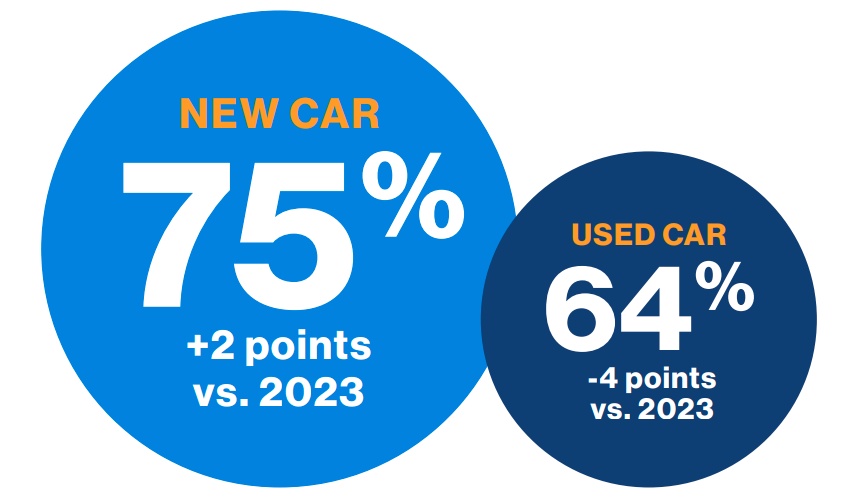
There’s a reason omnichannel improvements correlate with better buyer experience. In a major buyer-journey report, new-car buyer satisfaction hit 75% (vs. 64% for used), with improvements tied to digital tools that connect online and in-person steps.
Smoother transitions build trust, and trust creates action.
Turn browsing into booked test drives
Most vehicle sites accidentally bury the moment of intent. A shopper goes from “this might be it” to “I’ll do it later,” and later never comes.
You fix that by building conversion paths that feel natural.
Path 1: The decisive shopper
They’ve already picked the model. They want availability and a clean next step.
- Prominent “Schedule a test drive” placement (above the fold, not in the footer)
- Minimal form fields (you can always collect more later)
- Confirmation that feels real (time slot, location, what to bring, what happens next)
Path 2: The uncertain shopper
They like the vehicle, but they’re not ready.
- Save/compare tools that don’t punish them for hesitating
- Payment estimator that’s understandable
- Trade-in estimate that doesn’t feel like a trap
- Q&A content that answers common objections
Path 3: The “local reality” shopper
They’re thinking: “Is this even available near me?”
- Make “Find a Dealer” a clear, persistent option (especially on mobile)
- Show what changes by location (inventory, incentives, service)
- Don’t force them to hunt for basics like address or hours
Remove the friction that kills conversion
In high-consideration purchases, friction is subtle. It comes from:
- Confusing pricing language
- Unclear availability
- Forms that feel like lead traps
- Missing next-step expectations
- Too many clicks to book anything
One way to respect buyer anxiety is to acknowledge the financial reality. In one recent set of auto payment statistics, the average new-car payment sat between $700 and $800 (Q3 2025), and 20.3% of new-car payments were over $1,000.
| Credit Score Range | New Cars | Used Cars |
|---|---|---|
| 781 to 850 (super prime) | $41,695 | $29,836 |
| 661 to 780 (prime) | $45,944 | $28,770 |
| 601 to 660 (nonprime) | $45,944 | $26,425 |
| 501 to 600 (subprime) | $40,646 | $23,231 |
| 300 to 500 (deep subprime) | $36,236 | $21,427 |
When shoppers are staring at those numbers, they want clarity.
Bottom line
A great showroom used to be a building you drove to. Now it’s an experience you carry in your pocket. When your site makes the vehicle feel real and the buyer feel confident, you stop begging for leads and start earning test drives.