
Gurgaon’s road network is a study in contrasts. Eight lanes of smooth tarmac on the Dwarka Expressway sit a few kilometres from broken service roads in a nearby sector, and monsoon season turns underpasses along the Delhi border into shallow ponds.
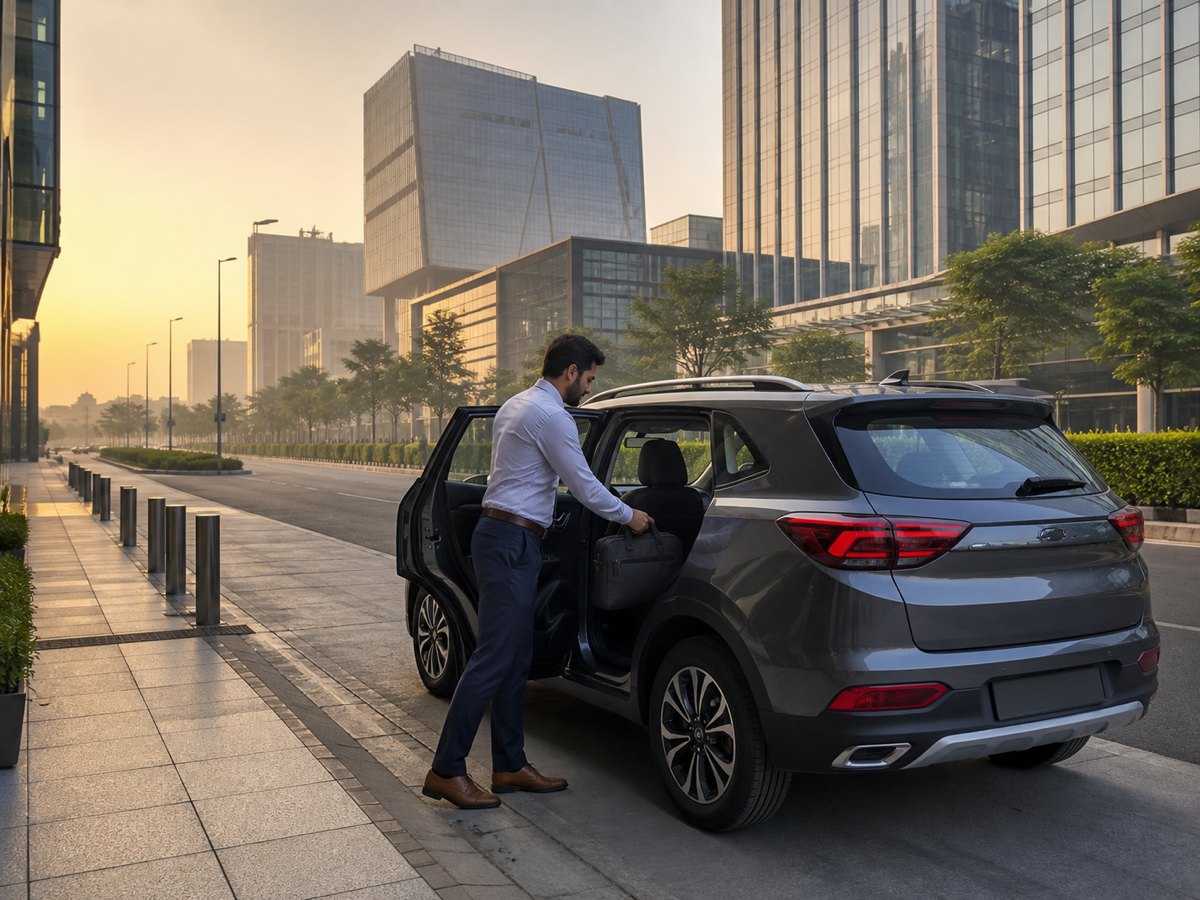
Anyone commuting daily between Cyber Hub and Sohna Road figures out pretty quickly what a suspension can absorb – and what it can’t. That calculation, repeated across thousands of households, explains why compact SUVs fill so many condominium basements here.
What Gurgaon roads actually ask of a daily driver
The demands are specific. Unmarked speed breakers in Old Gurgaon, sudden lane closures near construction sites, water collecting at Narsinghpur during heavy rain, long crawling stretches on NH48 during evening peak.
A car that clears a flooded stretch without swallowing water through the air intake saves an owner from a repair bill that easily runs into six figures.
This is why buyers scanning listings for second hand cars in Gurgaon often filter by body type before they filter by budget. The numbers are straightforward.
Most compact SUVs sit between 190mm and 210mm of unladen ground clearance, while comparable hatchbacks in the same price bracket sit closer to 165mm. Thirty millimetres sounds trivial. On a diagonal speed breaker taken at an angle with four passengers aboard, it’s the difference between a clean pass and an underbody scrape that costs you at the next service.
The visibility and suspension argument
Ground clearance is only part of it. Compact SUVs place the driver’s hip point higher, which changes what you can actually see in dense traffic.
Spotting a two-wheeler weaving between lanes three cars ahead is materially easier from a raised seating position, and Gurgaon traffic rewards early warning. Tyre profile matters just as much and gets discussed far less. A compact SUV typically runs something like 215/60 R16 rubber, giving a taller sidewall than the 185/65 R15 fitted to most hatchbacks.
That extra sidewall acts as a secondary cushion over sharp expansion joints and pothole edges, protecting the alloy rim and the suspension bushings.
The part nobody tells you is how much suspension travel quietly does. Longer travel means the damper absorbs an impact rather than transmitting it through the body shell, which is why compact SUVs feel less unsettled on broken surfaces even when their ride is firmer at low speeds.
How the segment compares on paper
Here’s a snapshot of what buyers typically weigh when shortlisting within the segment.
| Model | Unladen ground clearance | Boot space | Typical used price band |
| Hyundai Creta | around 190mm | 433 litres | Rs 8L to 14L |
| Tata Nexon | around 208mm | 382 litres | Rs 5 to 12 lakh |
| Maruti Brezza | around 198mm | 328 litres | Rs 5 to 12 lakh |
| Hyundai Venue | around 190mm | 375 litres | Rs 6 to 10 lakh |
Price bands shift with variant, fuel type, and ownership history, so treat these as orientation rather than valuation. What the comparison shows is how tight the segment is on clearance, and how much it diverges on boot capacity.
That’s usually the deciding factor for families making weekend runs to Delhi or Jaipur. Clearance gets you there. Boot space determines whether you’re arguing about luggage the entire way.
Buyers weighing a Hyundai Creta used car against a newer sub-four-metre option often find the decision comes down to generation rather than badge. Most people assume newer always means better. That’s only half the story.
The second generation Creta, sold from 2020 onwards, introduced features like ventilated seats that earlier versions never had. For anyone parked under the sun on Golf Course Road through a Delhi summer, ventilated seats stop being a luxury tick-box and start being daily equipment.
The trade-offs worth accepting honestly
Compact SUVs involve real compromises.
Kerb weight is higher. Real-world fuel economy trails an equivalent hatchback by two to three kilometres per litre in stop-start conditions, sometimes more on a grinding NH48 evening.
Tyre replacement costs more because the sizes are larger. Parking in the tighter lanes of Sadar Bazaar or older Sector markets takes patience, and reverse camera quality becomes genuinely important rather than a nice extra on the spec sheet.
Dual-clutch automatic gearboxes deserve particular scrutiny here. They work well on open expressway runs. In prolonged crawling traffic, they can hunt between gears in ways that get exhausting fast.
A torque converter or AMT may suit a heavy urban commuter better. Service history on any automatic should be checked line by line, not just glanced at. I’ve seen buyers skip this step and regret it after the first major service bill.
None of these drawbacks outweighs the core benefit for most Gurgaon households. The city punishes low-slung cars. Buyers have simply adjusted their shortlists accordingly, not because of brand loyalty or marketing, but because the roads taught them to.