
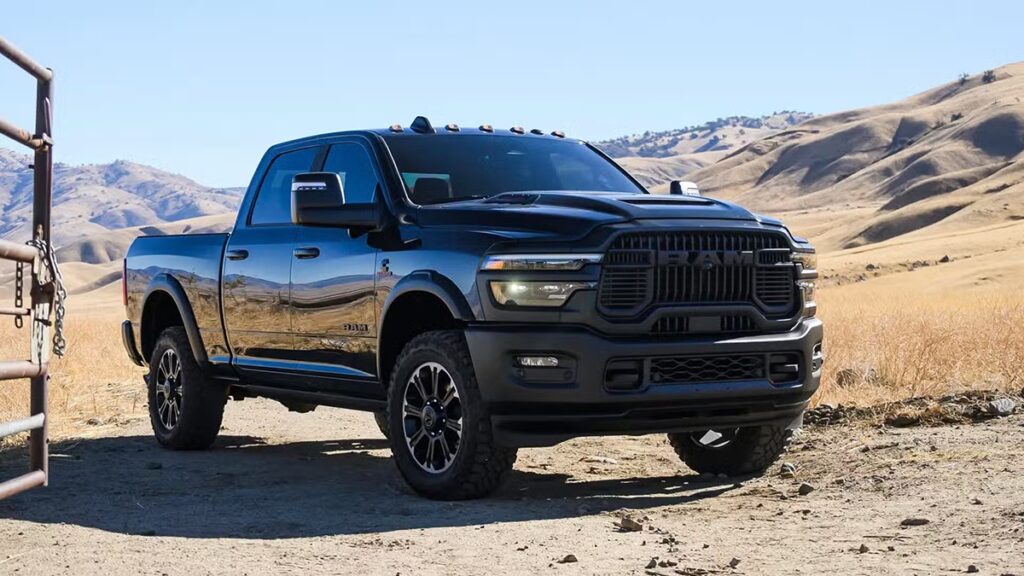
A practical guide for European Ram owners navigating emissions hardware failures, inspection realities, and off-road upgrade options.
Introduction
The Ram 2500 and 3500 offer heavy-duty capability unmatched by European vans and trucks. However, the 6.7L Cummins’ emissions system was calibrated for North American highways. European driving patterns—frequent stop-start urban traffic, cold winters, and lower average speeds—create a severe mismatch. The result is premature DPF clogging, heavy EGR carbon buildup, and frustrating limp-mode scenarios. Here is why it happens and what performance-focused owners are doing about it.
In This Article:
Why the DPF and EGR Struggle in European Driving Conditions
Why DPF Passive Regeneration Fails in European Traffic
The DPF requires sustained speeds above 60–70 km/h for 20–30 minutes to burn off soot naturally. In dense European traffic, this rarely happens. The truck is forced to rely on active regeneration, which frequently gets interrupted by short trips, leading to a rapidly clogged filter.
EGR Contamination in Stop-Start and Cold-Climate Conditions
Short, cold commutes prevent the engine from reaching the sustained temperatures needed to self-clean the EGR passages. Soot becomes sticky, rapidly coating the EGR valve and intake manifold, and causing early EGR cooler failure due to thermal cycling stress.
Common Fault Codes and Symptoms
European Ram owners typically encounter a recognisable sequence of fault codes as emissions hardware begins to fail. Understanding what each code indicates helps owners plan maintenance realistically.
| Fault Code | System | Likely Cause | Typical EU Workshop Cost | Notes |
| P2002 | DPF | DPF efficiency below threshold — soot accumulation | EUR 1,500–3,500 (DPF replacement) | Most common first sign in urban-use trucks; often appears at 60k–100k km in European conditions |
| P0401 | EGR | Insufficient EGR flow — valve contamination or cooler restriction | EUR 400–1,200 (valve) / EUR 800–2,000 (cooler) | Accelerated onset in cold short-trip cycles; valve cleaning is temporary relief |
| P20EE | SCR / DEF | NOx catalyst efficiency below threshold — SCR catalyst or DEF system fault | EUR 1,200–3,000 | Often follows DPF issues; SCR efficiency drops when DPF backpressure is elevated |
| P0087 | Fuel system | Fuel pressure below specification — can be secondary to high exhaust backpressure | EUR 300–900 | Can appear alongside P2002 in trucks with severely clogged DPF |
| Limp mode | ECU protective state | Multiple stored fault codes trigger power reduction | Diagnostic + repair of root cause | Power reduced to approximately 50% of normal; most disruptive during loaded driving or towing |
Understanding Your Options as a European Owner
Option A: OEM Repair Route
Best for: road-registered trucks, owners within the AGT/Ram dealer warranty period, trucks used for light-duty European service.
OEM replacement of a failed DPF, EGR cooler, or EGR valve restores the truck to factory specification and maintains full emissions compliance. The practical limitation is recurrence. If the underlying driving pattern has not changed, the new filter will accumulate soot at the exact same rate.
Option B: Preventive Maintenance to Extend System Life
Best for: road-registered trucks where owners want to delay the onset of failure and reduce regen frequency without modifying the emissions system.
• Forced active regen using a diagnostic tool: Software like AlfaOBD allows the driver to manually trigger a forced active regeneration.
• Quality diesel fuel additives: Cetane improvers reduce the rate of incomplete combustion and soot production.
• Periodic motorway runs: A regular 45–60 minute motorway run at sustained speeds allows passive DPF regeneration to complete.
These measures reduce failure frequency but do not eliminate it. For trucks in intensive urban service, they buy time — not a permanent solution.
Option C: Delete Kit Route (Off-Road and Track Builds)
Best for: off-road-only vehicles, competition trucks, farm and agricultural equipment, trucks deregistered from public road use in jurisdictions that permit this.
For trucks not required to pass roadworthiness inspections, a systematic delete approach removes the failure-prone emissions hardware entirely. The result is a truck running on its native Cummins engine performance without the emissions control overlay.
• DPF delete pipe: Replaces the factory DPF section of the exhaust with a straight pipe, eliminating filter clogging, forced regeneration cycles, and DPF-related fault codes.
• EGR delete kit: Seals off the EGR valve and cooler circuit with CNC-machined block-off plates, coolant reroute fittings, and high-temp gaskets — eliminating carbon accumulation in the intake path.
• A delete tune is non-negotiable: The 6.7L Cummins ECU continuously monitors EGR and DPF sensor outputs. Without a matching ECU recalibration, the truck will immediately set fault codes and may enter limp mode, reducing power output to approximately 50%. The hardware and software are inseparable components of the modification.
The 6.7L Cummins Performance Upgrade Path
For off-road builds, the upgrade sequence below delivers the most reliable and comprehensive outcome. Order matters — particularly the requirement to tune the ECU before removing hardware.
Step 1: DPF Delete Pipe
Select a 4″ or 5″ diameter turbo-back or downpipe-back pipe matched to your model year. When upgrading, installing a precision-bent Ram 2500 DPF delete pipe eliminates filter clogging, forced regeneration cycles, and restrictive backpressure.
Step 2: EGR Delete Kit
Block off both the EGR valve port and EGR cooler ports with CNC-machined stainless block-off plates. A complete Cummins EGR delete kit from a reputable supplier will include all necessary coolant reroute fittings to bypass the EGR cooler circuit — a critical step to prevent air pockets in the cooling system.
Step 3: CCV Reroute Kit
The crankcase ventilation system routes oil-laden blow-by vapours through the intake on the 6.7L Cummins. A CCV reroute kit redirects oil-laden blow-by vapours away from the intake path, keeping intercooler piping and intake manifold walls clean.
Step 4: ECU Tuning — The Critical European Consideration
The 6.7L Cummins ECU continuously monitors EGR and DPF sensor outputs. A delete tune is non-negotiable. For 2018–2021 trucks, a Security Gateway bypass cable is absolutely mandatory to allow the tuner to communicate with the ECU.
The All-in-One Delete Kit Option
Rather than piecing a system together across multiple shipments, performance specialists like EngineGo offer bundled packages. For European owners ordering from North American suppliers, choosing diesel all-in-one delete kits is strongly recommended. This approach guarantees that the DPF pipe, EGR plates, and specific ECU tuners are perfectly compatible with your exact model year.
Selecting Parts That Fit Your Ram — European Buyer Considerations
Model Year Fitment
The 6.7L Cummins delete kit market divides into three primary year ranges, each with different EGR routing, DPF configurations, and ECU generations. Ordering the wrong year range results in mismatched block-off plates, incorrect pipe flanges, and incompatible tuner files.
| Model Year Range | EGR Kit Generation | DPF Pipe Fitment | Tuner Requirement | Bypass Cable? |
| 2007.5–2009 | Gen 1 Cummins EGR | Turbo-back, 4″ or 5″ | EFI Live / EZ LYNK | Not required |
| 2010–2012 | Gen 2 Cummins EGR | Turbo-back or downpipe-back | EFI Live / EZ LYNK | Not required |
| 2013–2017 | Gen 3 Cummins EGR | Turbo-back or downpipe-back, 4″ or 5″ | EZ LYNK or EFI Live AutoCal V3 | Not required |
| 2018–2021 | Gen 4 — Security Gateway | Downpipe-back, 4″ or 5″ | EZ LYNK + bypass cable REQUIRED | Yes — mandatory |
| 2022–2024 | Gen 5 — EZ LYNK AutoAgent 3 | Downpipe-back, 4″ or 5″ | EZ LYNK AutoAgent 3 + app | Yes — included in kit |
BUDGET REALITY — SHIPPING, CUSTOMS DUTY, AND VAT FOR EUROPEAN ORDERS
A 4″ or 5″ diameter stainless steel exhaust pipe is a large, heavy item. Shipping from the United States to Europe involves costs that first-time importers often underestimate.
- International freight: Ranging from USD 150 to USD 400+.
- EU Import Duty: Typically 2–4% on automotive exhaust parts.
- VAT: Calculated on the combined value of the goods + shipping + duty (usually 19–25% depending on your specific country).
Logistics Tip: When ordering your parts from EngineGo, ensure you track your heavy freight closely. Once the package is in transit, using a universal global tracking platform like 17track.net is an excellent way to monitor your shipment’s progress in real-time as it clears international customs and is handed off to your local European courier.
Cab and Chassis Compatibility
Standard pickup cab and bed configurations are compatible with all mainstream delete kit offerings. Cab and chassis (C&C) trucks — typically used in commercial applications with flat beds, dropside bodies, or service bodies — are generally NOT compatible with standard pickup exhaust routing kits due to different frame lengths, exhaust exit positions, and body mount configurations. Always confirm your cab and bed configuration explicitly when ordering.
Materials and Quality Standards
• Exhaust pipes: 409 stainless steel is the standard for delete pipes. In regions with heavy winter road salt usage (Germany, Scandinavia, UK, Alpine countries), 304 stainless is worth considering for superior corrosion resistance despite its higher price point.
• EGR block-off plates: CNC-machined billet construction — not cast or stamped. Confirm plates include all required gaskets and coolant reroute fittings for your specific model year.
• Tuner inclusion: Always purchase a kit that explicitly includes a compatible tuner and, for 2018+ trucks, the Security Gateway bypass cable. Sourcing the tuner and bypass cable separately as international orders adds complexity, cost, and potential compatibility risk.
Conclusion
European driving conditions and the 6.7L Cummins emissions system are a predictable mismatch. The short-trip urban cycles, cold climates, and stop-start traffic that characterise much of European driving accelerate DPF clogging and EGR carbon buildup at rates the system was not calibrated to handle.
While road-registered trucks must rely on OEM repairs to pass strict TUV/MOT tests, off-road and competition builds can achieve permanent reliability through a comprehensive delete approach. By sourcing bundled kits from trusted brands and budgeting properly for import logistics, European owners can unlock the true potential of their American heavy-duty trucks.